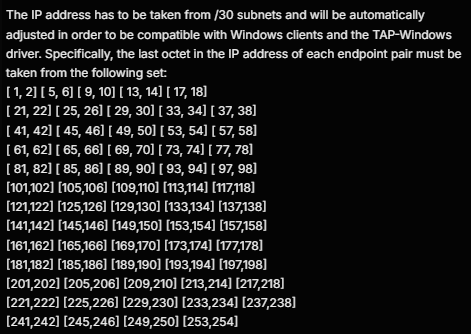
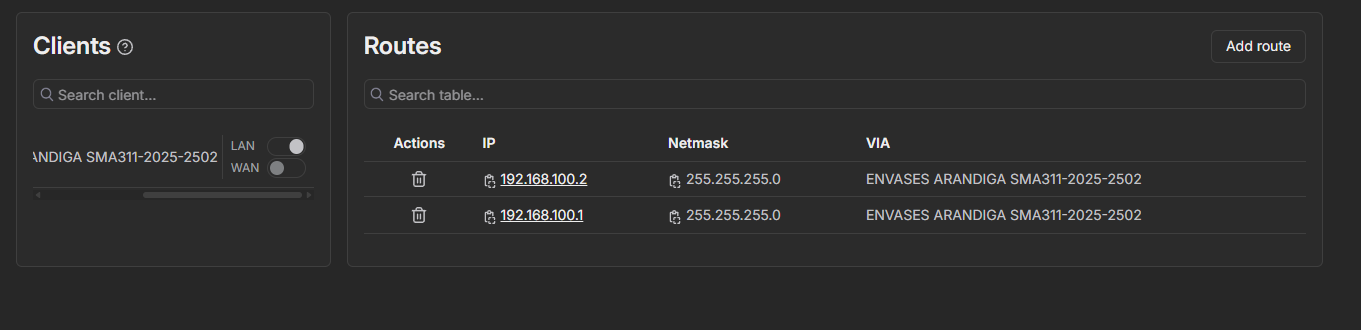
I’ve set up a VPN Hub on my own computer and saw that I also get the .252 subnet assigned to the client, which looks to be normal behaviour due to limitations of the TAP Drivers.
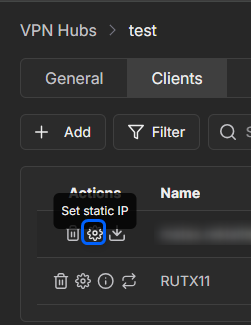
After discussing a little with the RMS team, there seems to be some information given about this under RMS VPN Hub → Clients → “Set static IP” option:
As for changing it, according to what the RMS Team has told me - it is not possible. Is there any specific reason as to why you need the 255.255.255.0 subnet?
The routes you’ve set under the Routes tab will still work as intended. Say you have 192.168.1.0 → 255.255.255.0 → via RUT241 set up, you’ll be able to reach any device in the LAN that is under that specified subnet.
On the remote site with the RUT 241 I have a network of PLC controllers connected. I am able to access the web pages if I specify the route, but I am not able to use my engineering software to access/discover these devices. When connecting with my software I connect to the devices IP but the Subnet has to be in the same range in order for it to connect successfully.
If we are given VPN access to a site from a clients server, say CISCO, then they just ensure we land on that VLAN in the same IP and subnet range and we are able to connect, no issues.
Generally speaking, if the ‘engineering software’ you mention is on your PC, and your PC is also connected to the VPN Hub, both the PC & The software must see the RUT200 device & the end devices behind it.
If you were to open up the Windows Command Prompt once connected to the VPN, and if you tried pinging your end device, would you get any response at all?
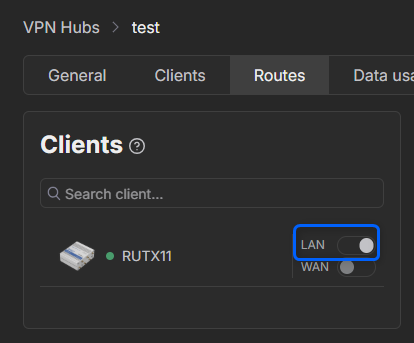
What route do you currently have set up in your RMS VPN Hub? Could you provide a screenshot? Do you have LAN forwarding enabled under the Route tab as seen here:
I have a very similar issue.
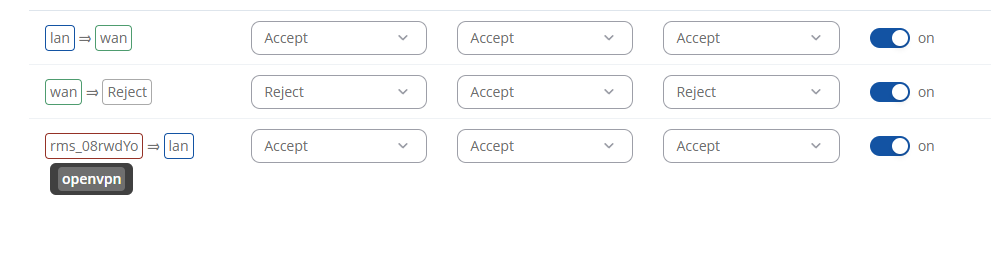
I have enabled Masquerading and as you can see openvpn instance have this enabled as well. Still I a can not access or ping the devices in the lan.
Could you send a photo of your routes table in the RMS VPN Hub settings? Preferrably, so the device & the full routes are visible. Would need to see if WAN/LAN forwarding are enabled, depending on what kind of network you have.
Would also like for you to elaborate a bit more on how you have everything connected and from where you’re trying to reach what.
2 Devices connected locally on eth0 without gateway, only static IPs and subnet.
RUTX11 connected on the web by WWAN at the moment
Remote PC:
PC is actually at the same wan without any physical connection to the eth0 of RUTX11 whatsoever. Wan is actually coming from another RUTX11 we use as office router and has a 4G sim card for connection to the internet.
Using the standard procedure to connect to the vpn with OpenVPN Connect
There’s your issue. You’re making a route to a direct IP address, but the subnet you’re configuring is for the entire 192.168.100.0/24 subnet.
If you’re adding a direct IP address, in your case for example, 192.168.100.1, the netmask must be /32 (255.255.255.255)
Either:
Delete & edit the routes to be 192.168.100.2/32 & 192.168.100.1/32 (255.255.255.255)
Or delete both routes, and add a single route that would be for the entire subnet, so you wouldn’t need to have multiple ones. For example 192.168.100.0/24 (255.255.255.0)