When I invert an EYE Sensor (BTSMP1) ~180°, I expected the broadcast
pitch/roll to reflect the new orientation within a second or two. Instead,
the values step up gradually and take ~30s after the move to settle on the
full inverted orientation. I’m completing the flip in about 5 seconds.
Questions:
Is this ~30s settling time expected?
Is the gradual stepping a firmware filtering/averaging behavior, and is
it configurable?
Is there a setting that would let the sensor report the new orientation
within a few seconds of the move?
What you’re observing can depend on how the BTSMP1 data is being collected.
The pitch/roll values are carried in the sensor’s Scan Response packet which is only available when a receiver performs an active BLE scan.
As a result the update rate you see is determined by three factors:
The BTSMP1 advertising interval (20 ms–10 s, default 5 s).
The BLE scan cycle of the receiving device.
Any additional transport/reporting delay between the receiver and the platform.
If you’re reading the values through a Teltonika FM tracker a ~30 s update time is generally consistent with the tracker’s BLE scanning behaviour rather than the BTSMP1 itself.
The tracker scans periodically so although the sensor may be broadcasting updated orientation data every few seconds, the tracker only picks up new values when its next scan occurs.
This can make the pitch/roll appear to change in steps over roughly 30 seconds.
If you’re viewing the sensor directly in the EYE App however a 30 s plateau would not normally be expected, since the app performs active scanning and should update much closer to the configured advertising interval.
To achieve orientation updates within a few seconds, we recommend:
Reducing the BTSMP1 advertising interval (for example, to 2–3 seconds).
If using a Teltonika FM tracker, enabling Non Stop Scan / continuous BLE scanning.
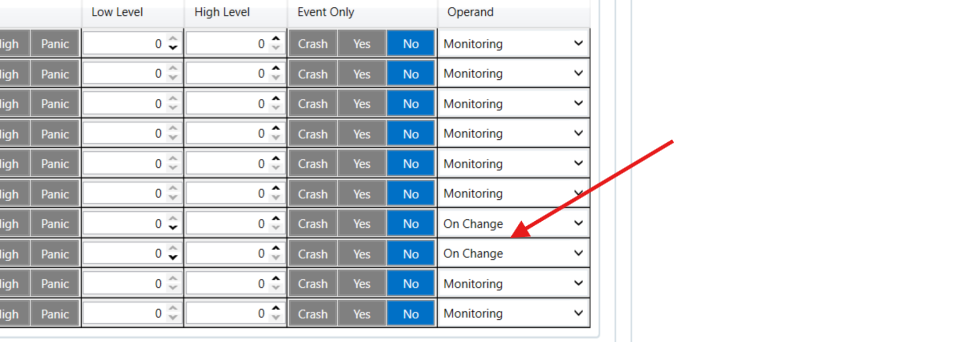
Configuring event-based reporting (e.g., On Change) so updated values are transmitted immediately rather than waiting for the next periodic record.